
Artist Technique — The How | Vikash Jha Studios
Artist Technique — The How

Texture Is Not
Decoration.
It's the Argument.

"Every layer of texture offers me an opportunity to bring my abstract expressions closer to my imagination."

— Vikash Jha
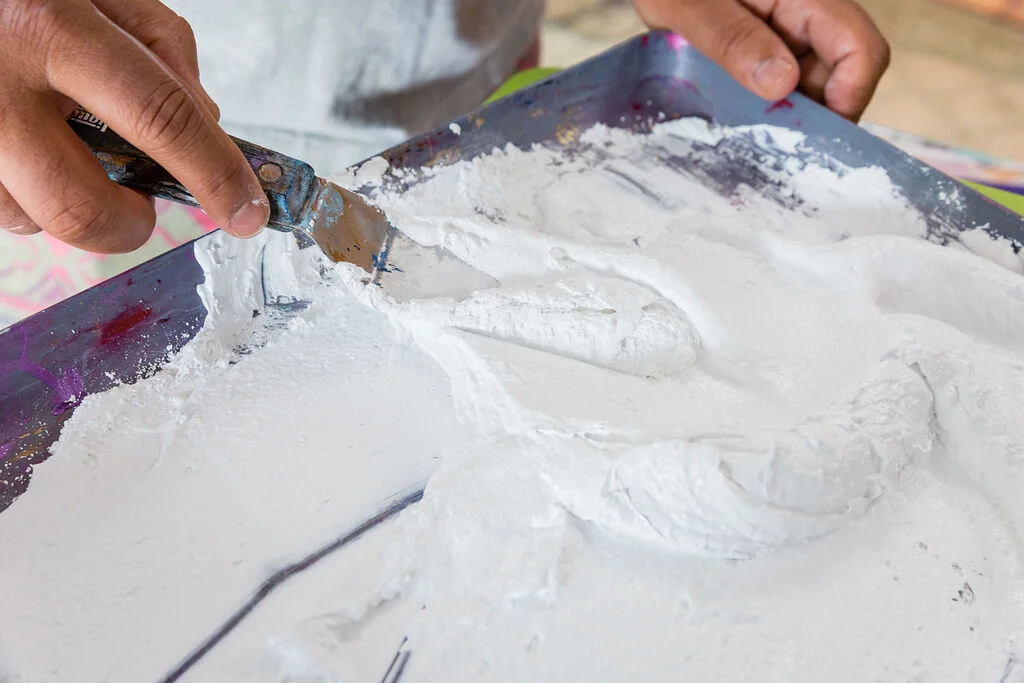
Detail · Mixed Media Surface · Studio
The How

Nothing Is Wasted. Nothing Is Fixed in Advance.

Vikash Jha builds his paintings the way he was trained to build a position — start with a thesis, but stay open to what the material actually tells you. Every piece begins with an idea and ends somewhere the idea alone couldn't have predicted.

"During the creative process, I invariably improvise on my original ideas, getting constantly excited about the unknowns in the process," he says. "Oftentimes this helps me achieve better outcomes than I could have otherwise achieved."

The Process

From First Mark to Finished Surface

A single VJS painting can carry five or six material layers before it's finished — each one added, scraped back, and reworked in response to what the layer before it did. This is the sequence, in broad strokes.

01
The Idea
Every series starts as a question — about origin, memory, identity, or the environment. The question sets direction. It does not dictate the outcome.
02
The Ground
Acrylic, marble powder, cement, sand, or glass mediums build the base texture on canvas, canvas panel, or custom plywood — the physical terrain the rest of the piece will respond to.
03
The Build
Palette knives, conditioned brushes, scrubbers, scrapers, sponges, and mark-makers layer oil, charcoal, pastels, and spray paint — plus upcycled materials: wire, bolts, screws, thread, fabric, discarded objects.
04
The Improvisation
The original idea gets revised in real time. A layer that doesn't work gets scraped back, not painted over. What emerges from the unknowns is often better than the original plan.
Materials & Tools

Texture Has a Critical Role

"Texture has a critical role in my works, as every layer of texture offers me an opportunity to bring my abstract expressions closer to my imagination," Jha explains. Nothing on the surface is incidental — including the parts of it that were never meant to be paint.

"When the ideas are not held within rigid boundaries, they achieve logical harmony through experimental and experiential freedom."

— Vikash Jha, Artist Statement
Paint & Pigment
Acrylic, oil, charcoal, pastels, spray paint, and other pigments and bases — mixed freely within a single surface rather than kept in separate lanes.
Structural Mediums
Marble powder, cement, sand, and glass mediums — used to build physical dimension into the canvas before color is ever applied.
Upcycled Materials
Wires, bolts, screws, threads, fabrics, and other discarded, mundane materials — recontextualized as fine art surface elements, not disguised as something else.
Tools
Palette knives of different types, specially conditioned paintbrushes, scrubbers, scrapers, sponges, and mark-makers — each chosen for what it does to a specific material, not used interchangeably.
Technique by Series

The Medium Changes With the Question

Global Warming
Acrylic, recycled wires, bolts, screws, fencing net scraps, discarded fabric
The material choice is the argument: beauty built from what was already thrown away, on custom plywood canvas rather than a conventional stretched surface.
Inception
Acrylic, marble powder, 24K gold paint, crackle paste, sand, spray paint
Gold paint and crackle paste carry the weight of the subject — the origin of nature and humanity — without resolving it into a single answer.
Introspection
Acrylic, oil pastels, crackle paste, glass beads, micaceous iron oxide, spray paint
Glass beads and micaceous iron oxide catch light differently depending on the viewer's position — echoing a series built around shifting internal emotion.
Illusions
Acrylic, marble powder, 24-carat gold paint, mixed media
Gold paint appears again here, deliberately — used to render the material illusion the series critiques, rather than to celebrate it.
Transcendence
Acrylic, sand, marble powder, beads, crackle medium, stencils
Stencils introduce the only repeatable, deliberate mark-making tool in the studio's process — used sparingly, for a series about a force beyond the artist's own hand.
Confluence
Acrylic, marble powder, crackle and pouring mediums, upcycled Indian cotton and synthetic fabric, spray paint, gold and bronze paints
Two fabric traditions are physically layered into the same canvas — a literal confluence of Indian textile and American materials, not just a visual metaphor for one.
From Canvas to Collector

The Discipline Doesn't Stop at the Easel

An original painting becomes a print through the same rigor Jha applies to a finance decision — every step measured, and the edition size fixed before the first print ever runs, not after demand appears.

01
Photograph the Original
The finished painting is professionally photographed to preserve true color and texture.
02
Set the Edition Size
The cap — permanently 50 for Limited Editions — is decided before a single print is produced, not adjusted later.
03
Museum-Quality Giclée
Prints run on archival paper built to hold color and detail for decades, not just for a first impression.
04
Sign, Number, Document
Limited Editions are hand-signed and numbered (e.g. "12/50") with a Certificate of Authenticity. Open Editions are serial numbered, not signed.
05
Retire the Design
Once a Limited Edition sells out, that design is permanently retired. No reprints — the scarcity is a binding commitment, not a marketing line.
Open Editions
Unlimited run. Museum-quality giclée on archival paper. Serial numbered, not signed. Ships with an Artist's Note card explaining the piece.
Limited Editions
Capped permanently at 50 per design. Hand-signed and numbered. Certificate of Authenticity included. Once sold out, retired for good.
Originals
One of one. The physical piece described above, materials and all — no print, no reproduction, acquired through direct consultation.
Why This Matters to You

The Process Is the Provenance.

Knowing what's actually in a piece — the recycled wire, the 24K gold paint, the marble powder ground beneath it — is part of what you're collecting. It's also why the edition math never moves after the fact: the same discipline that manages a portfolio position manages the print run.